Low-Pressure Mercury UVC Lamps
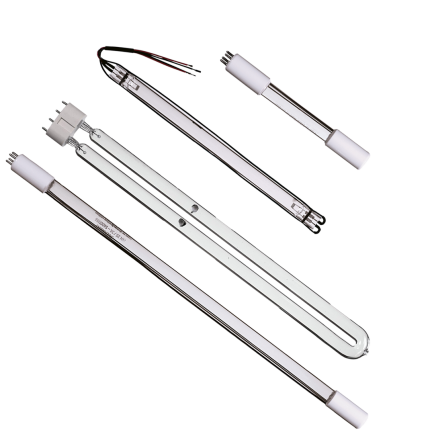
Excelitas offers a wide variety of Noblelight UV low-pressure and germicidal lamps made from high-quality quartz glass, that are specifically designed for disinfecting water, air, and surfaces. When synthetic quartz glass is used as lamp material, it emits 185 nm and 254 nm UV radiation (vacuum UV). This combination promotes oxidation processes that help eliminate pollutants, odors, and grease. Our NNILight UV low-pressure lamps are available in 800, 1000, or 1500W for maximum flexibility to address your specific application requirements.
Our Noblelight UV low-pressure lamps come in various lengths and styles, including different end connectors, rod shapes, or U-shaped designs. U-shaped lamps, in particular, provide higher output in a more compact format.
Depending on the application, using highly efficient and space-saving lamps is beneficial. Available in 800, 1000, or 1500W, our NNILight series ensures reliable drinking water disinfection while maintaining the lowest total cost of ownership.
High-efficiency, low-pressure mercury lamps deliver 30% to 60% greater output with a spectral peak at 254 nm and operate without producing ozone. In contrast, standard low-pressure mercury lamps, made from either synthetic or natural quartz glass, generate ozone and have spectral outputs at both 254 nm and 185 nm.
Lamps contain mercury. Manage in accordance with local, state or federal disposal laws.
Conventional low-pressure lamps:
| Ozone-free | Ozone-generating | |
| Spectrum: Wavelength | 254 nm | 185 nm, 254 nm |
| Arc length | 10 – 150 cm | 10 – 150 cm |
| Electrical power | 5 – 80 W | 5 – 80 W |
| Typical UV efficiency at 254 nm | 40% | 40% |
| Typical efficiency at 185 nm, natural quartz glass | - | approx. 6% |
| Typical efficiency at 185 nm, synthetic quartz glass | - | approx. 9% |
| Specific UVC flux | 0.1 – 0.4 W/cm | 0.1 – 0.4 W/cm |
| Use at ambient temperatures | up to max. 40°C | up to max. 40°C |
| Service life | 9,000 h with 30% decline of UV intensity | 9,000 h with 30% decline of UV intensity |
High-output low-pressure lamp:
| Ozone-free | Ozone-generating | |
| Spectrum: Wavelength | 254 nm | 185 nm, 254 nm |
| Arc length | 10 – 150 cm | 10 – 150 cm |
| Electrical power | 10 – 150 W | 10 – 150 W |
| Typical UV efficiency at 254 nm | 25-35% | 25-35% |
| Typical efficiency at 185 nm, natural quartz glass | - | approx. 6% |
| Typical efficiency at 185 nm, synthetic quartz glass | - | approx. 9% |
| Specific UVC flux | 0.2 – 0.5 W/cm | 0.2 – 0.5 W/cm |
| Use at ambient temperatures | up to max. 60°C | up to max. 60°C |
| Service life | 9,000 h with 30% decline of UV intensity | 9,000 h with 30% decline of UV intensity |
- High UV efficiency (40%)
- Low energy consumption
- Customizable to specific requirements
- Output 30% to 60% higher than with lamps made of soft glass
- Low surface temperature
- Disinfection of water - municipal drinking water, sewage treatment plants and air-conditioning
- Reduction of pollutants in industrial exhaust air
- Hospital air disinfection
- Grease and odor control for foodservice kitchens
Conventional low-pressure lamps:
| Ozone-free | Ozone-generating | |
| Spectrum: Wavelength | 254 nm | 185 nm, 254 nm |
| Arc length | 10 – 150 cm | 10 – 150 cm |
| Electrical power | 5 – 80 W | 5 – 80 W |
| Typical UV efficiency at 254 nm | 40% | 40% |
| Typical efficiency at 185 nm, natural quartz glass | - | approx. 6% |
| Typical efficiency at 185 nm, synthetic quartz glass | - | approx. 9% |
| Specific UVC flux | 0.1 – 0.4 W/cm | 0.1 – 0.4 W/cm |
| Use at ambient temperatures | up to max. 40°C | up to max. 40°C |
| Service life | 9,000 h with 30% decline of UV intensity | 9,000 h with 30% decline of UV intensity |
High-output low-pressure lamp:
| Ozone-free | Ozone-generating | |
| Spectrum: Wavelength | 254 nm | 185 nm, 254 nm |
| Arc length | 10 – 150 cm | 10 – 150 cm |
| Electrical power | 10 – 150 W | 10 – 150 W |
| Typical UV efficiency at 254 nm | 25-35% | 25-35% |
| Typical efficiency at 185 nm, natural quartz glass | - | approx. 6% |
| Typical efficiency at 185 nm, synthetic quartz glass | - | approx. 9% |
| Specific UVC flux | 0.2 – 0.5 W/cm | 0.2 – 0.5 W/cm |
| Use at ambient temperatures | up to max. 60°C | up to max. 60°C |
| Service life | 9,000 h with 30% decline of UV intensity | 9,000 h with 30% decline of UV intensity |
- High UV efficiency (40%)
- Low energy consumption
- Customizable to specific requirements
- Output 30% to 60% higher than with lamps made of soft glass
- Low surface temperature
- Disinfection of water - municipal drinking water, sewage treatment plants and air-conditioning
- Reduction of pollutants in industrial exhaust air
- Hospital air disinfection
- Grease and odor control for foodservice kitchens
Additional Resources
Excelitas Low-Pressure Mercury UVC Lamps generate ultraviolet radiation at 254 nm, the wavelength most effective for germicidal performance.
When electrical current passes through mercury vapor inside the quartz glass tube, it produces UVC light that penetrates microbial cells, damaging their DNA and RNA. This prevents bacteria, viruses, and other pathogens from reproducing or surviving.
Lamps made with synthetic quartz also emit 185 nm light for oxidation and odor control applications, providing customers with precise wavelength options and reliable operation in demanding industrial environments.
Mercury UVC lamps are used in many sectors where controlled disinfection or oxidation is required, including:
- Water and Wastewater Treatment: These lamps provide efficient sterilization and oxidation within purification and recycling systems for critical water processes.
- Food and Beverage Manufacturing: In production and packaging lines, the lamps help sustain hygienic conditions and improve overall product quality.
- Pharmaceutical and Medical Production: UVC systems provide consistent air and surface disinfection, supporting compliance with stringent hygiene standards.
- HVAC and Cleanroom Systems: When integrated into air-handling equipment, the technology maintains controlled, contaminant-free air quality essential to precision manufacturing.
- Industrial Exhaust and Coating Lines: By promoting oxidation of airborne pollutants and odors, these systems contribute to cleaner, safer, and more sustainable production environments.
For optimal results, installation should be performed by trained personnel to ensure proper electrical connections and adequate ventilation.
Regular cleaning of the quartz sleeve maintains maximum UV transmission. Avoid frequent on/off cycling and ensure cooling systems operate correctly to extend lamp life. Routine inspection of the lamp surface, connectors, and reflectors helps sustain uniform UV output across long production cycles.
Installation should always be carried out by trained personnel to ensure correct alignment, proper electrical connections, and adequate ventilation.
Once installed, a clean quartz sleeve should be maintained for consistent UV transmission and disinfection performance. Cooling systems should be kept in proper working condition to prevent excessive heat buildup and extend lamp life. Frequent on/off cycling should also be avoided, as it can reduce electrode lifespan and overall stability.
Yes. Excelitas works directly with customers through engineer-to-engineer collaboration to create custom lamp configurations and seamless system integrations. Each design is tailored to match specific process goals, encompassing wavelength optimization, geometry, and housing.
Our technical teams also provide installation guidance, validation support, and maintenance advice to ensure long-term reliability and efficient operation.