Photoionization Detector Lamps
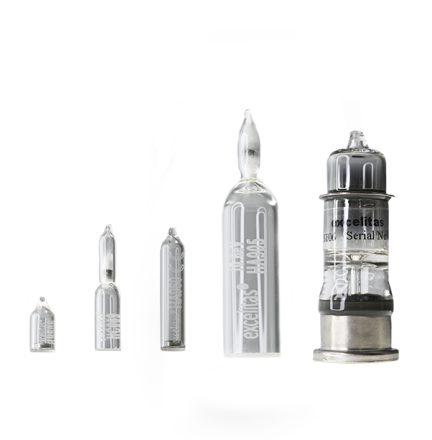
Excelitas offers a complete range of DC and RF-operated Photoionization Detector (PID) lamps with the highest intensity, spectral purity, and long life, making them ideal for detecting Volatile Organic Compounds (VOCs). Our decades of experience in lamp design and manufacturing are leveraged to ensure our customers benefit from the highest product quality and reliability. Our DC and RF excited PID lamps are available with a selection of gas fills and window materials to cater to the specific requirements of your VOC sensor project.
Photoionization detector lamps are most commonly used in VOC gas detection. Gas chromatography (GC) and sample ionization for mass spectrometry are other areas of use. The PID technique uses a lamp with known photon energies in the vacuum ultraviolet (VUV) region. The lamp output is used to photo-ionize gaseous molecules with ionization potentials lower than the photon energy emitted. Typical photoionization detectors measure VOCs and other gases in concentrations ranging from the ppm to ppb level.
- Various gas fillings (e.g. xenon, krypton)
- Different sizes available of RF (6x14mm, 6x30mm 12,7x52mm) and DC (19,6x53,5mm)
- Range of window materials with different cut: off wavelengths
- Lamps with DC or RF (radio frequency excitation)
- Ionization energies from 8.4 eV to 10.6 eV
- A variety of gas fills and window materials with photon energy 8.4 – 10.6 eV for more selectivity in gas detection
- High purity window material for better transmission and higher intensity
- Proprietary getter technology and high purity gas fill for longer lamp life
- Reliable processes and highest quality lamps due to semi-automated production
- VOC gas detection
- Gas chromatography (GC)
- Mass spectrometry (MS)
- Field monitoring of air and soil
- Emergency first response
- Jar headspace screening
- Leak detection
- Personnel safety in confined spaces
- Explosives Trace Detection (ETD)
- Narcotics Detection
- BTEX - detection (Lamp PKR 100-6-14 recommended)
- Various gas fillings (e.g. xenon, krypton)
- Different sizes available of RF (6x14mm, 6x30mm 12,7x52mm) and DC (19,6x53,5mm)
- Range of window materials with different cut: off wavelengths
- Lamps with DC or RF (radio frequency excitation)
- Ionization energies from 8.4 eV to 10.6 eV
- A variety of gas fills and window materials with photon energy 8.4 – 10.6 eV for more selectivity in gas detection
- High purity window material for better transmission and higher intensity
- Proprietary getter technology and high purity gas fill for longer lamp life
- Reliable processes and highest quality lamps due to semi-automated production
- VOC gas detection
- Gas chromatography (GC)
- Mass spectrometry (MS)
- Field monitoring of air and soil
- Emergency first response
- Jar headspace screening
- Leak detection
- Personnel safety in confined spaces
- Explosives Trace Detection (ETD)
- Narcotics Detection
- BTEX - detection (Lamp PKR 100-6-14 recommended)