PART/ mag.x 125
mag.x 125 Widefield Microscope System
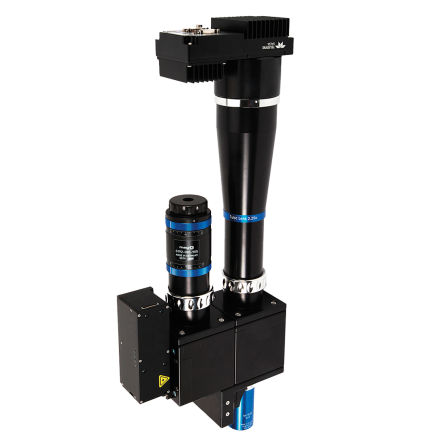
The Optem® mag.x 125 widefield microscope system represents a new class of optical systems, combining microscope-like resolution with wide fields of view to support modern high-resolution sensors up to 57 mm in diameter. Its enhanced autofocus capability delivers exceptional speed, precision, and reliability for advanced metrology and inspection applications. The fully modular design can be configured for a wide range of applications, from a straightforward optical system without illumination to a fully featured configuration incorporating coaxial illumination and closed-loop autofocus.
High-speed, high-precision autofocus capability
The Optem mag.x 125 widefield microscope system features an updated autofocus sensor and focus actuator hardware, delivering fast, precise, and repeatable performance for demanding inspection and metrology applications. Designed for high-throughput inspection of flat-panel displays, wafers, and advanced packaging, the system combines rapid focus tracking with nanometer-level Z-axis positioning to maintain image quality, measurement accuracy, and throughput.
Modular design for high-resolution imaging
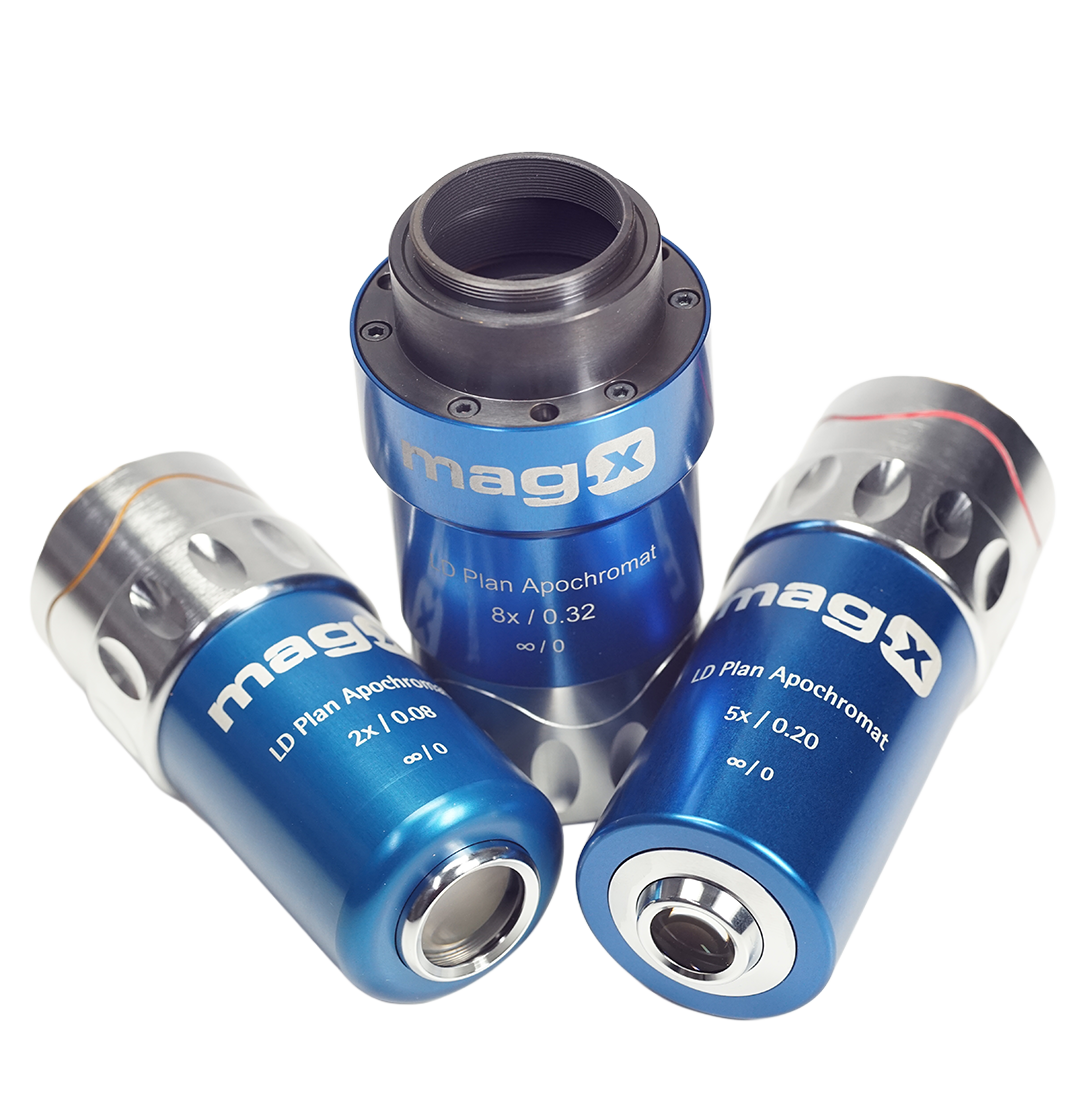
High-resolution inspection applications demand flexibility, precision, and seamless integration. The mag.x 125 system offers a fully modular platform that can be easily integrated with a wide range of objective lenses, tube lenses, illumination tubes, autofocus modules, mounting plates, and other accessories to meet specific application requirements.
| Objective Lens - Plan Apochromat | Tube Lens System | |||||||||||||||
| Mtub : 1x | Mtub : 2.25x | |||||||||||||||
| f'tub : 250 mm | f'tub : 563 mm | |||||||||||||||
| 2y' : 25 mm | 2y' : 56.3 mm | |||||||||||||||
| Magn./NA | WD | f'obj. | δ obj | R0 | M | 2y | NA' | R'0 | M | 2y | NA' | R'0 | ||||
| mm | mm | µm | lp/mm | mm | lp/mm | mm | lp/mm | |||||||||
| 2x/0.08 | 24 | 125.0 | ± 42.7 | 293 | 2.0 | 12.5 | 0.04 | 147 | 4.5 | 12.5 | 0.018 | 65 | ||||
| 5x/0.20 | 13 | 50.0 | ± 6.8 | 733 | 5.0 | 5.0 | 0.04 | 147 | 11.25 | 5.0 | 0.018 | 65 | ||||
| 8x/0.32 | 23 | 31.3 | ± 2.7 | 1172 | 8.0 | 3.1 | 0.04 | 147 | 18.0 | 3.1 | 0.018 | 65 | ||||
NA Numerical aperture in the object space; NA=n * sin (σ)
WD Working distance
f'obj Focal length of the objective lense
f'tub Focal length of the tube lens
δobj Depth of field at 546 nm; δobj = ± n * λ/(2*NA2)
R0 Cut off frequency in object space at 546 nm; R0 = (2*NA) / λ
R0' Cut off frequency in image space at 546 nm; R0' = R0 /M
2y' Image field size (maximum detector diagonal)
2y Object field size
M Magnification of the overall system; M = Mobj * Mtub
Precision engineering with innovative optical design
Exact telecentricity on both the object and image sides
Diffraction-limited optical performance across the complete image circle
Precise and dynamic autofocus
Modular, configurable architecture for easy system integration
Semiconductor inspection and processing
Flat-panel display processing (TFT and OLED)
Printed circuit board (PCB) processing
Micro measurement and metrology
Fluorescence microscopy
Digital pathology
| Objective Lens - Plan Apochromat | Tube Lens System | |||||||||||||||
| Mtub : 1x | Mtub : 2.25x | |||||||||||||||
| f'tub : 250 mm | f'tub : 563 mm | |||||||||||||||
| 2y' : 25 mm | 2y' : 56.3 mm | |||||||||||||||
| Magn./NA | WD | f'obj. | δ obj | R0 | M | 2y | NA' | R'0 | M | 2y | NA' | R'0 | ||||
| mm | mm | µm | lp/mm | mm | lp/mm | mm | lp/mm | |||||||||
| 2x/0.08 | 24 | 125.0 | ± 42.7 | 293 | 2.0 | 12.5 | 0.04 | 147 | 4.5 | 12.5 | 0.018 | 65 | ||||
| 5x/0.20 | 13 | 50.0 | ± 6.8 | 733 | 5.0 | 5.0 | 0.04 | 147 | 11.25 | 5.0 | 0.018 | 65 | ||||
| 8x/0.32 | 23 | 31.3 | ± 2.7 | 1172 | 8.0 | 3.1 | 0.04 | 147 | 18.0 | 3.1 | 0.018 | 65 | ||||
NA Numerical aperture in the object space; NA=n * sin (σ)
WD Working distance
f'obj Focal length of the objective lense
f'tub Focal length of the tube lens
δobj Depth of field at 546 nm; δobj = ± n * λ/(2*NA2)
R0 Cut off frequency in object space at 546 nm; R0 = (2*NA) / λ
R0' Cut off frequency in image space at 546 nm; R0' = R0 /M
2y' Image field size (maximum detector diagonal)
2y Object field size
M Magnification of the overall system; M = Mobj * Mtub
Precision engineering with innovative optical design
Exact telecentricity on both the object and image sides
Diffraction-limited optical performance across the complete image circle
Precise and dynamic autofocus
Modular, configurable architecture for easy system integration
Semiconductor inspection and processing
Flat-panel display processing (TFT and OLED)
Printed circuit board (PCB) processing
Micro measurement and metrology
Fluorescence microscopy
Digital pathology